 CODE OF CONDUCT
For staff members
Clear guidelines for every staff member
Responsible corporate governance builds trust and ensures stability. At PORR, it is an integral part of all business areas. Ethical conduct, consistent compliance and the protection of human rights form the foundation of sustainable governance and are closely interlinked.
With clear standards of conduct, defined responsibilities, an effective compliance system and targeted training, PORR ensures that legal and ethical requirements are consistently met, both internally and throughout the entire value chain.
 CODE OF CONDUCT
Clear guidelines for every staff member
 CODE OF CONDUCT
The basis for successful and sustainable business relations
 COMPLIANCE
Principles for disclosing information, anti-corruption etc.
 GOVERNANCE
 GOVERNANCE
 GOVERNANCE
 CORPORATE SUSTAINABILITY
Responsible corporate governance is the basis for long-term success. For PORR, this means: acting transparently, adhering to clear rules and consistently preventing misconduct. Particularly in a complex and highly fragmented market environment such as the construction industry, a functioning compliance system builds trust – both internally and externally.

Transparency and compliance with rules are firmly embedded in PORR’s day-to-day operations.
The Code of Conduct for employees, as well as that for business partners, applies throughout the entire value chain. Together with the PORR Principles, they form the guidelines for moral, ethical, lawful and honest conduct and are the foundation for all business activities and decisions.
A look at the participation rate in compliance and anti-corruption training shows how widely this understanding is embraced within the company. After 88.7% in 2024, the participation rate in 2025 was already 96.5%, exceeding the set target of 95%. This demonstrates that the training programmes are well established within the company and are actively utilised.

To ensure that rules are not merely in place but are put into practice in day-to-day operations, PORR relies on several interlinked measures. Employee training on anti-corruption and compliance forms the basis of this: all staff receive regular training, supplemented by targeted courses for particularly sensitive roles.
In addition, special training programmes for apprentices apprentices and blue-collar workers foster an understanding of compliance at an early stage and directly within the operational environment. This ensures that the requirements are present not only at management level, but throughout the entire organisation.
By anchoring the function of Construction Compliance Ambassador, PORR is bringing the issue even closer to construction sites. The ambassadors act as on-site points of contact and help to raise awareness and embed standards into day-to-day working practices.
In addition, the planned ISO 37002 certification of the whistleblowing system further strengthens existing structures. It creates additional transparency and underlines the commitment to handling reports of misconduct securely, independently and in a traceable manner.

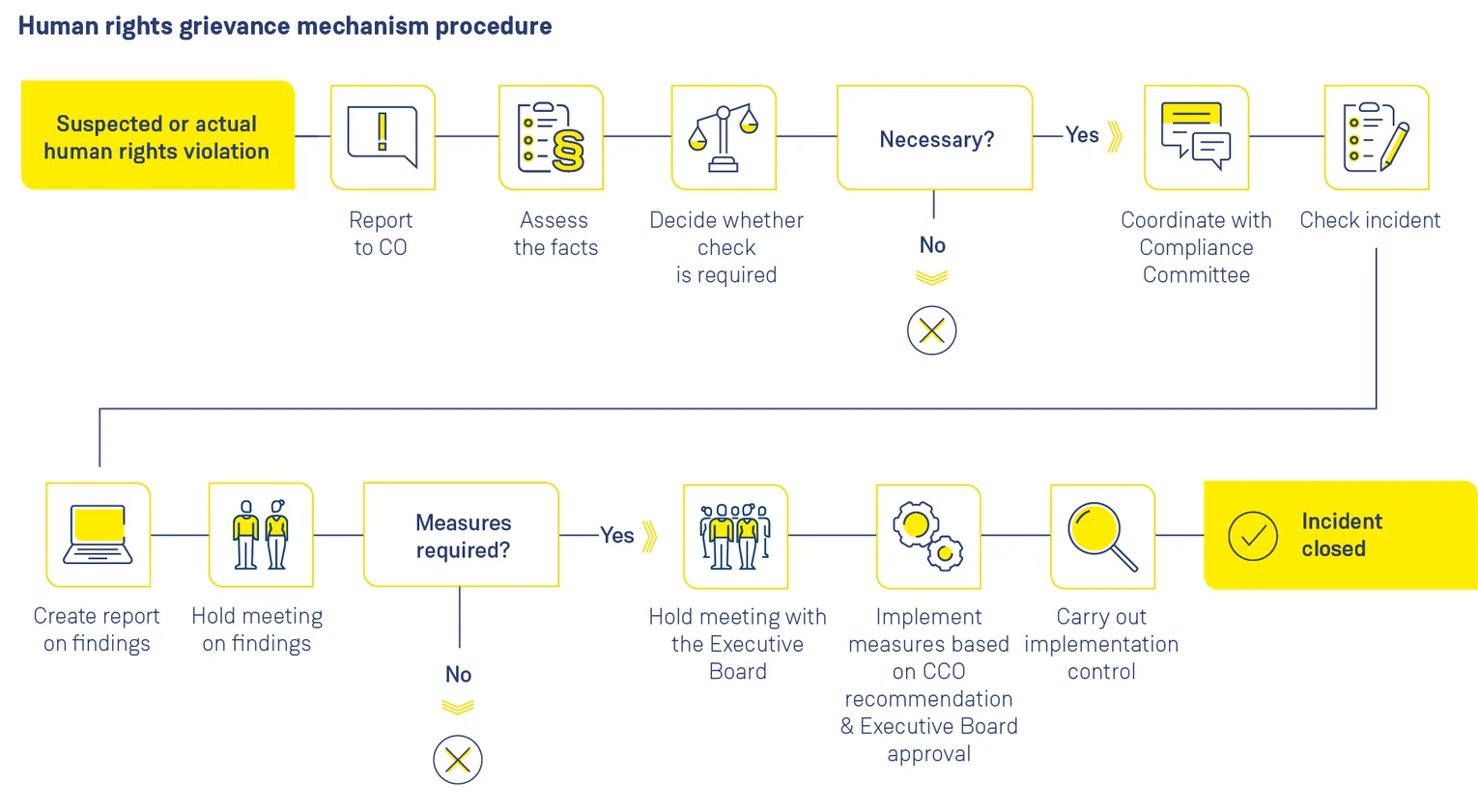
Respect for human rights is non-negotiable for PORR. It forms the basis for responsible conduct – both on the construction site and throughout the entire value chain. Particularly in a complex environment with numerous partner companies, it is crucial to identify risks at an early stage, create transparency and consistently implement clear standards.

The objective is clear: human rights must be protected and violations prevented throughout PORR’s sphere of influence.
Whether this target is achieved is demonstrated by a clear metric – the number of human rights incidents. The aim is to keep this figure permanently at zero. In the base year 2024, as well as in 2025, no human rights incidents were recorded.

To protect human rights effectively, PORR relies on a combination of monitoring, prevention and awareness-raising throughout the entire value chain.
A key component is human rights audits, through which around a third of sites are regularly reviewed. In 2024, this proportion stood at 29.5%, rising to 31.8% by 2025. This enables potential risks to be identified at an early stage and addressed in a targeted manner.
In parallel, the further development of human rights training is being driven forward. The training has been extended to an increasing number of employees and more firmly embedded within the company. The aim is, in particular, to fully involve managers and to firmly embed human rights due diligence obligations in day-to-day working practices.
We are also sharpening our focus in our collaboration with suppliers. With the expansion and group-wide roll-out of supplier risk assessments covering human and labour rights, risks are systematically analysed and evaluated. By 2025, 20.0% of relevant suppliers had already been assessed. Experience from individual markets is being used to establish a uniform, group-wide approach.
This creates a system that does not merely focus on control, but actively shapes responsibility – with the clear aim of permanently protecting human rights throughout the entire value chain.