Wewelsfleth / Wischhafen
SuedLink Elb crossing ElbX
Wewelsfleth / Wischhafen, Germany / 08.2023 - 12.2027
As part of the expansion of SuedLink, the route plan also includes a tunnel under the Elbe River. Germany’s largest transmission system operator, TenneT Germany, has commissioned PORR to construct the 5.2-kilometer-long tunnel between Schleswig-Holstein and Lower Saxony, through which high-capacity HVDC lines will transport wind power to the south starting in 2028. The tunnel is being constructed at a depth of approximately 40 meters using mechanical tunneling with segmental lining. To successfully realize this technically ambitious project, PORR is contributing its full range of expertise—from tunnel construction, civil engineering, and specialized underground construction to overall BIM coordination by pde Integrale Planung.

Facts & Figures
Company
PORR GmbH & Co. KGaA
Type
Alles aus einer Hand, Tunneling, Supply and disposal facilities, Turnkey construction pits
Runtime
08.2023 - 12.2027
A tunnel 20 m under the Elbe
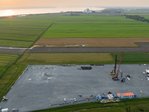
Construction of the ElbX Elbe crossing officially began with a symbolic groundbreaking ceremony in Wewelsfleth in September 2023. Immediately following the ceremony, preparatory work began, including the construction of site access roads, before the special civil engineering teams started excavating the starting pit. Subsequently, preparations for the receiving excavation pit also began on the Lower Saxony side in Wischhafen.
Challenging Diaphragm Wall Work in Winter
The complexity of the ground conditions became apparent as early as the winter of 2023. The diaphragm wall work in Schleswig-Holstein took place under difficult weather conditions, characterized by wind loads, softened soil, and challenging logistics. The team mastered these challenges with expertise—even the recovery of a 27-meter-deep granite-gneiss boulder shortly before Christmas only briefly put the construction work to the test and at the same time offered geologically interesting insights. By early 2024, 44 diaphragm walls had been constructed in the launch pit, the diaphragm wall box, and the sleeve structure, supplemented by 549 displacement piles to stabilize the future cable support areas.
Start of excavation and construction of the underwater concrete floor of the launch pit
In the spring of 2024, the work entered a new phase: After the diaphragm walls were completed on schedule, the first layer of reinforcement was installed in April. Shortly thereafter, wet excavation of approximately 25,000 cubic meters of marsh soil began. Since, for environmental reasons, no pressure pipe could be laid to regulate the water level, supplying the process water required for buoyancy control posed a significant logistical challenge. Close monitoring of the excavation floor and the diaphragm wall was necessary to rule out the risk of ground failure. Industrial divers supported the underwater work, removing sludge and suspension residues and preparing for the construction of the underwater concrete floor, which was installed starting in June 2024.
Factory acceptance of the tunnel boring machine
Meanwhile, preparations were underway for one of the project’s major milestones: the manufacture of the tunnel boring machine. In July 2024, the ceremonial factory acceptance of the 700-ton TBM, custom-built for SuedLink ElbX, took place at the Schwanau plant. The mixing shield is designed for the variable soil conditions beneath the Elbe—a sequence of clay, silt, peat, sand, gravel, as well as stones and boulders—and is equipped with a highly complex sealing system for operations at a depth of 40 meters. Following the acceptance, the machine was dismantled, transported to Wewelsfleth, and gradually reassembled in the launch pit so that mechanical tunneling could begin in early 2025.
Construction of the shaft buildings on both sides of the Elbe
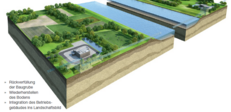
At the same time, work on the two shaft structures progressed rapidly. On both sides of the Elbe, 21-meter-deep and eight-meter-high shafts are being constructed, which will later ensure the connection of the six 525-kV DC cables to the tunnel and the joint buildings. Additional operational buildings are being erected above ground. On the Lower Saxony side, the challenging diaphragm wall work for the receiving pit was successfully completed in February 2025. The excavation pit was fully excavated, lined, and secured with stiffening layers. The smaller excavation pit for the jointing building was also fitted with an underwater concrete base, secured against buoyancy by micropiles.
Start of tunnel boring in early 2025
In February 2025, mechanical tunnel boring finally began. The TBM—christened Elsa—advances about ten meters through the ground each day and reached the “halfway point” in December 2025, having driven 50 percent of the tunnel route. The sections beneath the riverbed, where Elsa had to cut through the tough Lauenburg clay, were particularly challenging. Under the shipping channel, compressed air work at pressures of up to 4.8 bar was also required, which increased staffing requirements and limited working time at the cutterhead to about 50 minutes per shift.
Progress on the shaft structures
As tunneling continued to advance, significant progress was also made on the shaft structures: In Schleswig-Holstein, the second basement level was already under construction, while in Lower Saxony, work was underway on the fifth basement level. With the completion of the target excavation pit in 2025, the conditions were set for the TBM Elsa to break through at the target shaft in mid-2026.
Significance for SuedLink and the Energy Transition
ElbX has been on schedule since the start and is thus making a decisive contribution to the on-time commissioning of SuedLink in 2028. Then, six DC cables—including two emergency cables—will safely and efficiently transport wind power from northern Germany to the south via the 5.2-kilometer-long tunnel between Wewelsfleth and Wischhafen. SuedLink is a joint project of the transmission system operators TenneT Germany and TransnetBW. The northern section—and thus ElbX as well—is the responsibility of TenneT Germany. The project combines tunnel construction, specialized civil engineering, structural engineering, and cable installation in one of Germany’s most technically complex infrastructure projects and demonstrates how closely integrated collaboration leads to success.
See more pictures and videos about the project: