Wiesbaden
Friedrich-Ebert-Schule
Wiesbaden, Germany / 2021
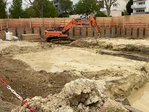
As a technology leader in specialist civil engineering, PORR is mindful of its responsibility towards the environment. The Düsseldorf branch demonstrated this with the construction pit underpinning it produced for the Friedrich Ebert School in Wiesbaden. The foundation was built with 379m3 of jet-grouted bodies using low-CO2 cement in order to be as environmentally friendly as possible. The CO2 savings are huge.

Facts & Figures
Company
PORR Spezialtiefbau GmbH
Type
Underpinning
Runtime
2021
DSV underpinning for the construction of a new school building
Underpinning for structures with foundations at different depths
The Friedrich-Ebert School on Balthasar-Neumann-Straße is being replaced by a new building. The new school building adjoins an existing workshop building and has deeper foundations than the adjacent existing structure. Before excavation work could begin, the existing foundations of the neighbouring building therefore had to be stabilised. To this end, PORR special civil engineering produced DSV bodies using the jet grouting method (DSV) and supplemented these with back-anchoring.
DSV structures for securing the existing building
A total of around 370 m³ of DSV structures were produced for the underpinning. The method serves to stabilise the subsoil and create load-bearing ground structures to secure existing buildings. The work was carried out taking into account the structural requirements of the existing building as well as the planned construction pit for the new building.
Use of a Portland composite cement
Around 570 t of Portland composite cement CEM II/C-M (S-LL) 42.5 N-NA was used to produce the DSV underpinning. Compared with a Class CEM I Portland cement, the cement used contains a lower proportion of clinker and utilises additional main constituents such as granulated blast furnace slag and limestone powder. According to the manufacturer, the production of this type of cement can result in lower CO₂ emissions compared with Class CEM I Portland cements. Reductions of up to 39 per cent are reported for the cement used. The supplying plant was located in Wiesbaden, approximately six kilometres from the construction site. The cement used was employed in the production of the DSV elements and was tailored to the project-specific requirements.
Verification of technical requirements
To verify the technical requirements, compressive strength tests were carried out in accordance with DIN EN 12390-3. The compressive strengths determined ranged between 6.2 and 6.8 N/mm². This met the project-specific minimum requirements of 3.5 N/mm². The test results confirmed the technical properties of the manufactured DSV elements required for the underpinning.
Foundation for the new construction of the Friedrich-Ebert-Schule
The construction of the DSV underpinning and the rear anchoring created the conditions necessary for the subsequent construction pits and structural works. These measures served to secure the existing building and facilitate the construction of the new Friedrich-Ebert-Schule in Wiesbaden.